
Social Media Isn’t the Only Online Platform for Book Marketing
As an author, you feel pressure to be present online to build credibility and an audience while running a digital marketing campaign for your book. Yet the push often focuses on social media, even though another platform is extremely valuable: blogging. While social media is critical for establishing an online community, blogging on your personal website gives you a unique home base you control, where you don’t have to worry about other posts diluting your message.
In Erin Penning’s blog, “Why blog? The benefits of blogging for business and marketing,” she says, “Blogging for business is still worth it because it helps companies build authority, increase organic traffic, generate leads, support SEO, and create content that keeps working over time.” Blogs are more than just articles on your website; they can drive your online presence everywhere.
Before you start getting nervous about another place where you need to invest your valuable time online, we are not suggesting you become a full-time blogger or post multiple times a week. We are going to show you why blogging for your book is valuable and how to get started creating useful content that can fuel your online presence—without taking all of your time.
Why You Should Be Blogging for Your Book
As you develop your social media presence (which you can learn about with this blog and this one), you’ll earn followers, but blogging helps you earn something much more valuable: readers.
While social media’s fickle algorithms change daily and you’re competing with countless other posts, a blog gives you a voice in your own space. When you have a steady stream of content on your blog that your readers resonate with, they keep coming back to you for more advice, research, or humor—whatever it is you provide.
This gives you a platform to build your unique brand and promote your book, all while creating one of the most valuable attributes you can have online: discoverability.
Blogging Helps Readers Find You Online
While social media posts seem to be there and gone, as far as the algorithm is concerned, quickly buried under a mountain of fresh content from other users, your blog gives you evergreen content that search engines can find.
That means if someone looks up a topic related to something you’ve blogged about, your website appears in the search results, and your advice is front and center for new readers. That means every new blog you write is a chance for a new reader to discover you!
Write What You Know to Build Up Your Readers
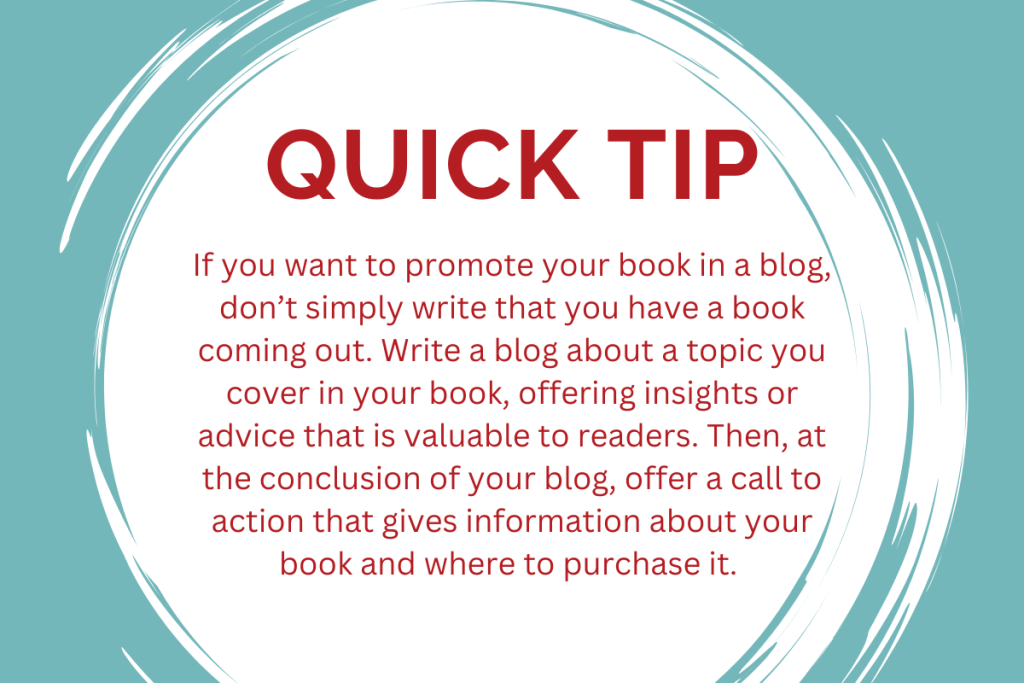
When we tell you to blog about your book, we don’t mean simply creating a post that says, “This is my book! You should read it!” Blogging is about building a knowledge base around your expertise. You should write about the topics you’re passionate about that inspired you to write your book in the first place. This could include:
- Knowledge related to your book’s topic.
- Advice, commentary, or research about your areas of expertise.
- Your unique perspective on world events, news in your industry, or other trending topics.
Creating this well of information on your personal website does something irreplaceable for your brand: It makes you trustworthy. When readers can count on you for useful, informative, down-to-earth content, they have more reasons to invest in you by buying your book.
Choose a Focus for Your Blog and Stick With It
However, before you start a blog, you need to decide what it will be about. The bullet points above can help you generate ideas, but you also don’t want to share any and every topic that interests you because refining your message is critical to establishing a loyal readership.
You need to refine your focus because discoverability becomes more difficult the more topics you cover. However, if you consistently post about the same topic, you set yourself up as an expert, both for your readers and for search engines.
Think of it this way: If you post a recipe on Monday, an engineering how-to on Wednesday, and a movie review on Friday, you are trying to attract vastly different audiences on one platform. However, when you narrow your focus to recipes, engineering, or movies and post weekly on that topic, you can start building a blog that a loyal readership looks forward to.
Refining Your Topic Helps You Choose Effective Keywords for Discoverability
Another important reason to narrow your topic focus for discoverability is keywords. If you’ve never heard that term, keywords are the specific words or phrases you use in your blog, social media, etc., to signal to searchers what your content is about.
For example, if you were writing a blog about hiking the Appalachian Trail, you would want to use keywords or phrases like:
- Appalachian Trail guide
- How to train for a long hike
- Appalachian Trail packing list
Using the key terms in your blog signals to search engines what your blog is about. Then, when people search similar terms, a search engine can point to your blog as a valuable resource of information. You should aim to include several relevant keywords in each of your blogs.
P.S. If you need help with keyword research, we recommend checking out the Semrush Keyword Magic Tool.
The Format for a Great Blog
Once you have some topic ideas for your blogs, you’re ready to start writing! However, you probably aren’t writing just for yourself; otherwise, you’d keep it offline. To make your blog a success online, meaning it shows up in Google search results, you need to optimize your blogs for searchability, categorization, and engagement.
Here’s how you can lay out your blogs to make them easy to read and engaging.
- Pick an eye-catching title. Search engines look for keywords, while people look for originality—so bring the two together. Choose a title that grabs attention and includes a key term from your post.
- Don’t make your paragraphs too long. When readers are looking through your blog for information, they want it to be easy to digest and understand. That’s why shorter paragraphs and bullet points work better for breaking up your content.
- Use headings effectively. As you transition through the blog topic, set up headings and subheadings so readers understand the flow of your blog.
- Add photos or graphics. Readers also don’t want to look at one solid wall of text. It’s a good idea to try to incorporate photos or graphics to engage your readers as they scroll through your blog.
- Add text to your photo. Unlike humans, search engines prefer words instead of pictures. So click on your image and change the title to something other than the default “IMG 25843” by describing the picture in a few words, preferably while including one of your keywords.
- Create a call to action at the end. Once you’ve written an effective blog, transition to a call to action for your conclusion. This is where you can point to your book, speaking engagements, courses, etc.
- Add some metadata. Most blogs have a basic metadata section beneath the area where you write your post, where you can add a brief title and description with your keywords. In the words of Jennifer G. from Writer Access, “Metadata is like a card catalog (remember those?) for digital content. It helps search engines, and it helps your website. In addition to identifying page titles and descriptions, metadata creates an organizational system. Specifically, metadata generates a taxonomy (Uh-oh, not another million-dollar-word!) within your content. This is just a fancy way of saying that metadata helps to create a hierarchical organizational scheme (That sounds fancy, too.) to identify, sort, and organize web content.” Search engines value this information for searchability, so make sure you fill it out for each of your blogs!
Blogging Gives You an Invaluable Resource: A Content Library
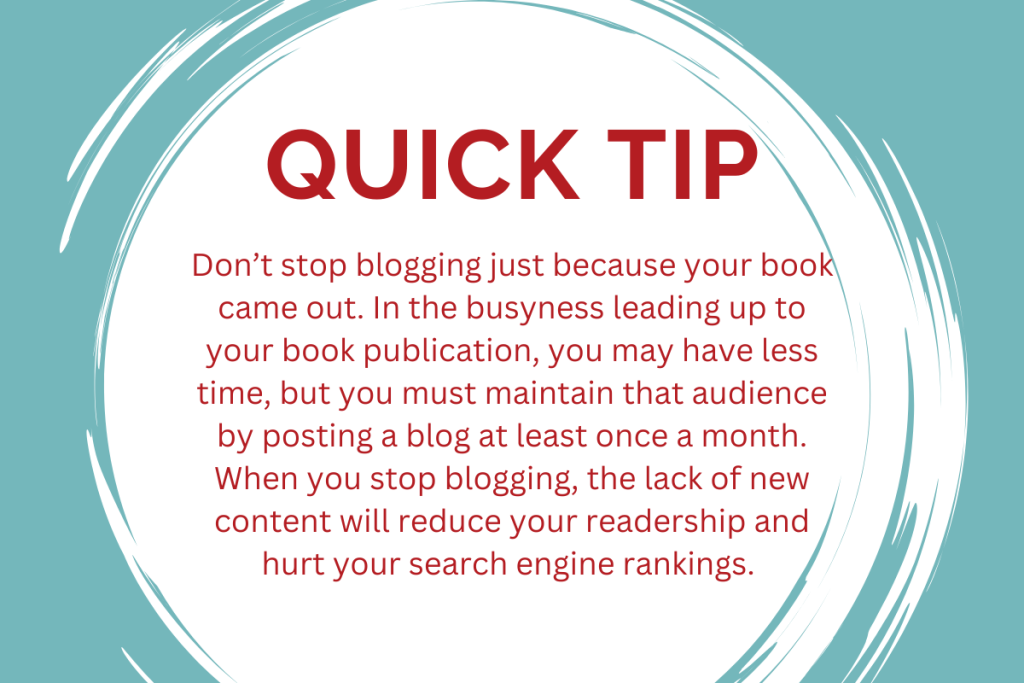
Once you get into the flow of blogging, we recommend trying to post a short blog once or twice a month. Why? Because blogging gives you a rich content library where you can generate valuable book marketing ideas for:
- LinkedIn posts
- Instagram carousels
- Facebook posts
- Pinterest graphics
- Email newsletters
- Short videos
- Quote graphics
- Podcast discussion topics
- Webinars
- And more!
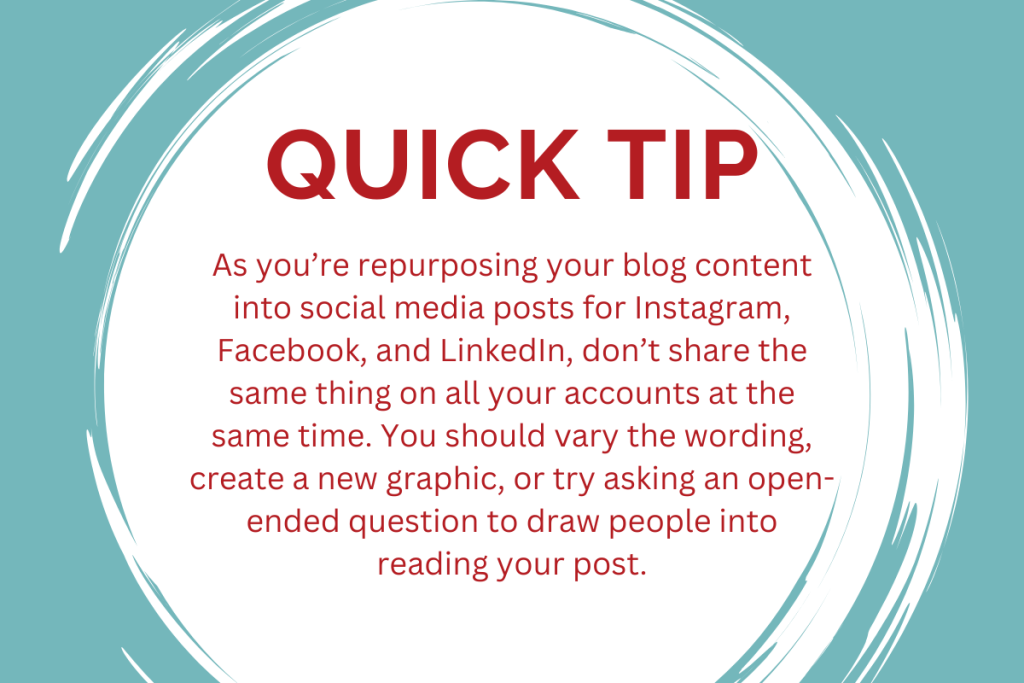
Every blog post you write doesn’t just live on your website; you can turn it into ready-made content to promote across your brand. How?
Did you write something on Facebook that struck a nerve? ➡️ Work it into a longer post for your blog or LinkedIn article.
Did you create an image on Instagram that received tons of likes? ➡️ Share it on Facebook or LinkedIn.
Organizing Your Content Library
However, having all these content ideas ready to be repurposed won’t do you much good if you can’t find anything. That’s why you need to organize your content library into a list of topics, both so you can repurpose what you’ve already written and to ensure you don’t write about the same thing twice.
Although it’s necessary, creating a promotional content library can quickly feel overwhelming. To stay on top of your content library, make it part of your blog creation process to capture the topic, organize it into your content library, and repurpose it into multiple types of content.
We like using an Excel or Google spreadsheet to organize ideas because you can neatly organize columns and search for keywords once your library becomes more extensive.
How Our Client Built a Blog That Drives His Brand
Our client, Bob Tiede, has a popular leadership blog, LeadingWithQuestions.com, where he shares insights on leadership through personal blogs and guest posts. He then turns these blogs into content for his LinkedIn profile and email newsletters, generating multiple veins of content from one blog post.
This strategy has helped him become extremely successful across all his platforms, with 16K monthly website visitors, 30K LinkedIn followers, and 13K email subscribers.
Read Bob’s full case study here to see how we helped him leverage his blog for more success online.
When You Should Start Blogging for Your Book
The best time to start blogging for your book is now! The great thing about a blog is that it provides evergreen content that can live and grow on your website across months and even years.
You don’t have to wait until you’re nearing your book’s publication to start blogging; you can begin building your content library now so you have a foundation of topics to pull from for social media once you’re ready to start building your brand and your book launch.
The Bottom Line
Blogging is a valuable way to build your online presence and create a content library you can draw from for social posts, podcast topics, and more. Writing blogs doesn’t have to be time-consuming: choose a focus, create a solid format, and settle on a regular publishing cadence. With a strong foundation of blog content, you’ll be on your way to building an audience of readers and growing your brand.
Take Action
Now that you understand the pivotal role blogging can play as an online platform for building book marketing ideas and growing your brand, it’s time to get to work. Start by coming up with a few topics to get you started on your first two to three blogs. Then, once you have several blogs on your website, compile the topics in a content library so you always have content at the ready to repurpose for social media and all elements of your book marketing toolkit.
If you need a hand with digital marketing for your book, Weaving Influence would love to help. We provide book marketing for authors, including website design, social media management, public relations, and more. We would love to help you build your brand to launch your book successfully!