Click here to listen on your device and subscribe!
Welcome to Indie Author Chat, the podcast designed to help you explore the ideas and insights behind today’s most thoughtful nonfiction books. Join host Laura Finch for engaging conversations with independent authors as they share the wisdom and inspiration behind their books—each title carefully curated by Weaving Influence Press.
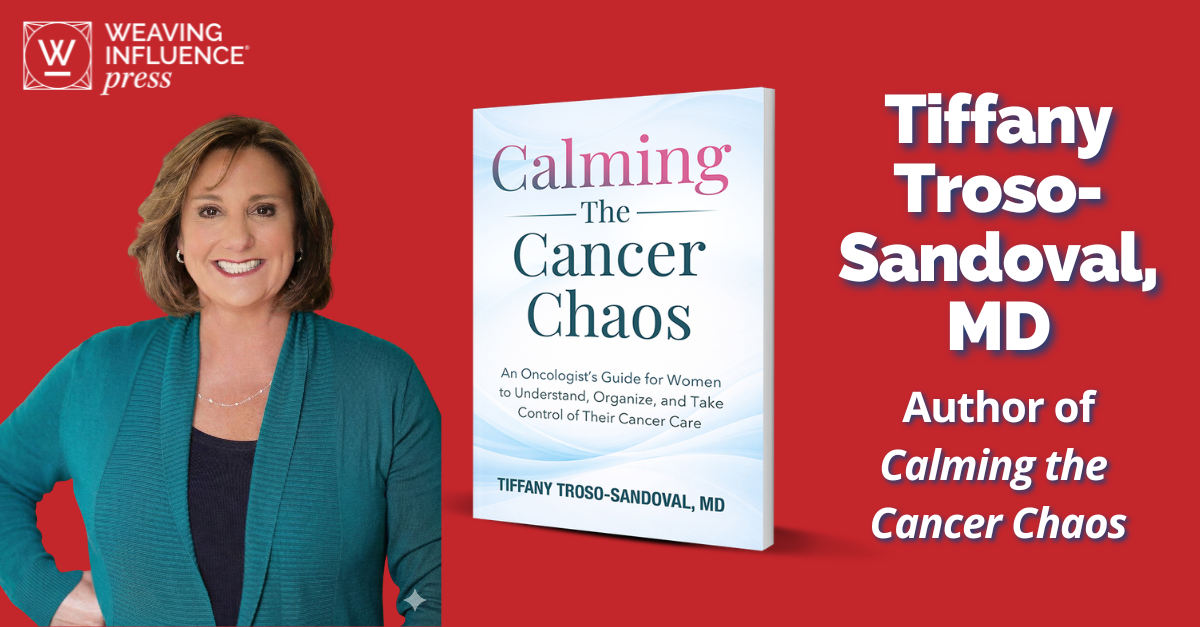
In this episode, Laura is joined by Tiffany Troso-Sandoval, MD, a medical oncologist with 25 years of experience at Memorial Sloan Kettering Cancer Center and the author of Calming the Cancer Chaos, a book that helps women take control of their cancer care. Laura and Tiffany discuss how cancer patients can navigate their diagnosis, advocate for themselves, understand clinical decisions, and lean on their support system. Although much is beyond a cancer patient’s control, Dr. Troso-Sandoval offers practical steps for managing the chaos and making this difficult diagnosis a smoother life transition.
Key Points From This Episode:
[01:43] Dr. Tiffany shares her personal background and how a degenerative eye condition led her to transition away from clinical practice and why she wrote her book, Calming the Cancer Chaos.
[4:44] Laura and Dr. Tiffany discuss cancer survival statistics, the diversity of patient journeys, and how patients deal with ongoing cancer.
[6:22] Dr. Tiffany outlines immediate steps patients should take following a cancer diagnosis, including processing the news independently and compiling comprehensive medical history lists to make appointments easier.
[11:27] Dr. Tiffany describes the “teach-back” method, which can help patients get a better understanding of their diagnosis and treatment.
[14:02] Dr. Tiffany outlines why seeking a second opinion isn’t always the best choice when you have an aggressive cancer diagnosis.
[18:53] Dr. Tiffany emphasizes the importance of patients organizing a support system to help with everyday tasks during their treatment.
[21:54] Dr. Tiffany and Laura discuss environmental toxins that can expose people to carcinogens.
[25:37] Dr. Tiffany shares a sweet personal story about how she met her husband.
[30:10] Dr. Tiffany describes the core mission of her book: To foster the “empowered cancer patient” through medical literacy, confidence, and self-advocacy.
[32:35] Dr. Tiffany discusses the role of AI in medical diagnoses today and why patients should be careful with what they research.
Resources:
- Order Calming The Cancer Chaos: An Oncologist’s Guide for Women to Understand, Organize, and Take Control of Their Cancer Care
- Follow Tiffany Troso-Sandoval, MD on LinkedIn.
Key Quotes:
Every patient’s journey and every patient’s cancer are very different. So how we manage your cancer is very specific not just to who you are and how you’re feeling, but also to the type of cancer. And I do want to bring attention to the fact that not everybody is cured. I mention that especially because when we talk about survivors, there are also so many thrivers. In other words, stage four cancer is not necessarily the same quote-unquote death sentence that it was years ago. We’re treating it more like a chronic disease. I mention that because, when patients are on continuous treatment, they often feel left out when we talk about survivors, who rang the bell and are all done. But there are so many more. – Tiffany Troso-Sandoval, MD
I always talk about the fact that the kiss of death is if you say to a patient, “Call me if you need anything.” Because they’re never gonna call you. But part of what I want to do is empower the patient to realize she needs to call on friends, family, and loved ones so she can free up the time and space to heal, rest, and get through her treatments. – Tiffany Troso-Sandoval, MD
My goal is to create what I call the empowered cancer patient. What that means is a patient who is going to be able to learn more about her cancer and be able to control the controllables that are available to her. Not everything in cancer care is controllable, but you can control many things. – Tiffany Troso-Sandoval, MD
Actively participate in your care. If you understand, you can communicate what you’re hearing and advocate for yourself much better in the office with your doctor and elsewhere. That’s what I call the empowered cancer patient: someone who has clarity, gains confidence, and can rally her own community to support her. It’s not gonna make cancer go away, but it can make the journey or the whole pathway a lot easier for people if you have the type of support and communication that you really need. – Tiffany Troso-Sandoval, MD
It’s in every cancer patient’s best interest to make sure they get credible information they can rely on. If you see something on social media and your doctor didn’t mention it to you, bring it up with them because there’s probably a good reason they didn’t. And there might not be as much real-world data behind whatever you think is gonna be the next cure or the replacement for a mammogram or what else you heard today. – Tiffany Troso-Sandoval, MD
Sign up for the bi-weekly newsletter to connect with Becky Robinson and learn about upcoming book launches.
Consider joining Team Buzz Builder, our book review team that supports most of our client launches. When you sign up for a launch, you’ll receive a complimentary copy (digital or print) in exchange for your commitment to post an early review.