Click here to listen on your device and subscribe!
Welcome to Indie Author Chat, the podcast designed to help you explore the ideas and insights behind today’s most thoughtful nonfiction books. Join host Laura Finch for engaging conversations with independent authors as they share the wisdom and inspiration behind their books—each title carefully curated by Weaving Influence Press.
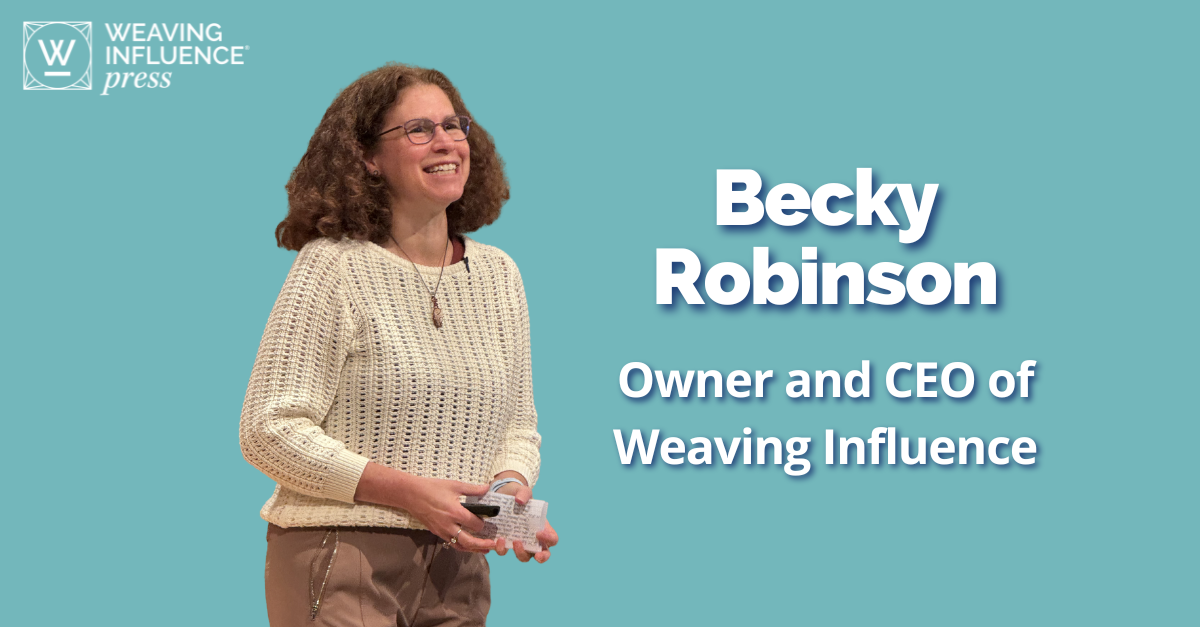
In this episode, Laura talks with Becky Robinson, owner and CEO of Weaving Influence, about the rise of AI in publishing and how authors should approach using AI when crafting books. Specifically, they discuss how AI can strip an author’s voice, making the book less impactful, and can make errors when providing information or relaying transcripts. They reinforce that publishing standards matter and books should maintain the integrity of human creation, editing, and design. Becky ends by encouraging authors to bring their unique experiences, stories, vulnerabilities, fears, and joys to creating their book, instead of relying on AI.
Key Points From This Episode:
[02:17] Becky discusses how she has seen a rise in the use of AI in writing and publishing.
[04:00] Becky explains the ways she is comfortable using AI, including for transcription and to extract exact quotes.
[06:18] Laura and Becky discuss the fallibility of AI and not relying on it for factual information.
[10:41] Becky shares how she believes AI should not have a place in publishing books because the integrity of books should be maintained.
[11:43] Laura and Becky discuss AI graphics and how using them can be inauthentic and reflect poorly on who posts them.
[14:35] Laura and Becky reflect on Carl Pritzkat (BookLife President) and his clip on AI-generated writing.
[18:36] Becky emphasizes that a distinct human voice makes writing more meaningful.
[20:02] Becky outlines Weaving Influence’s AI policy.
[22:45] Laura and Becky discuss AI “tells” and their stance on authors being upfront about their AI use.
[25:18] Becky reinforces why human writing matters and encourages authors to share their unique experiences through writing.
[27:46] Laura points out that it’s okay to change your mind about AI, for better or worse.
[28:32] Laura and Becky discuss how AI-generated content can negatively impact marketing, PR, and other opportunities for a book.
Resources:
- Learn more about AI in publishing with this statement from Dzanc Books.
- Read Weaving Influence’s AI Policy.
- Follow Becky Robinson on LinkedIn.
Key Quotes:
I personally don’t want to use AI to write anything for me ever. We often will say, “Use AI to take away words.” So I’m gonna write a first draft, and it might be messy, and I’m gonna let AI clean it up for me. But unfortunately, my feeling or opinion or experience is that when you do that, it strips away everything that makes your writing unique and interesting. So the idea that we can do a messy first draft and then let AI clean it up, you know, I think it’s taking away something essential from the process. I believe the best writing is created when a human being crafts, refines, edits, polishes, and proofreads it from start to finish. — Becky Robinson
As it relates to the publishing of books, there’s something a bit more sacred or careful in the way that we need to approach it. Because of the integrity of books and honoring the reader who’s going to pay money to read the book that we’re writing. — Becky Robinson
The bottom line is that writing a book always takes more time, energy, and money than an author thinks. And then once you’ve written the book, marketing it is also exceedingly difficult. So you want to make sure that you have the best possible product. The best possible product comes when a human takes care to write as well as they can and brings in a professional team to edit and refine the text. — Becky Robinson
There can be some AI tells in writing, and people joke a lot about things like the em dash. You know, I’ve always used a lot of em dashes in my writing, even before the advent of AI. So I’m not going to look at text and just because there are em dashes, you know, assume that it was written using AI. — Becky Robinson
The data shows that people are reading less and less, so why would we want to waste our time on something that was generated by an algorithm? I think what we all crave is real, genuine connection in our lives. And I would want that when I’m reading as well. When you read a book that’s written by a human, particularly if you’re reading nonfiction, if you’re reading prescriptive nonfiction or memoir, and you read a story that captures your heart, that is something only a human can do. — Becky Robinson
Each of us has to contribute whatever is most true and authentic about ourselves. It’s our own unique experiences; it’s our own unique stories; it’s our own vulnerabilities, our fears, our joys. And that human connection is what we all crave in our increasingly computerized, impersonal world. So in publishing, as in any other endeavor, the more you can bring your wholehearted self to what you’re doing, the more valuable and resonant it will be. — Becky Robinson
Sign up for the bi-weekly newsletter to connect with Becky Robinson and learn about upcoming book launches.
Consider joining Team Buzz Builder, our book review team that supports most of our client launches. When you sign up for a launch, you’ll receive a complimentary copy (digital or print) in exchange for your commitment to post an early review.